this exhibition was curated by
inna christine pabustan
from psy2b
click on the door to enter
this exhibition is entitled
HELPLESSNESS
Can't Help Myself
by Sun Yuan and Peng Yu, 2016
dreams, books, power and walls
by JANNABI, 2019
this is what self-destruction feels like
by Marina Lin, 2020
Anguish
by August Friedrich Schenck, 1878
The Unequal Marriage
by Vasilii Purkiev, 1862
Untitled (Perfect Lovers)
by Felix Gonzales-Torres, 1991
Blue Monday
by Annie Lee, year unknown

please click on the artwork to know more about the piece.
Can't Help Myself
by Sun Yuan and Peng Yu, 2016
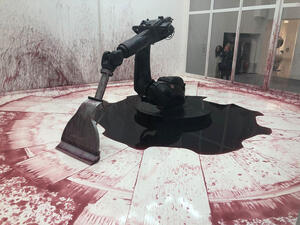
installation art
click on the artwork to see a video of the actual art.
# 1
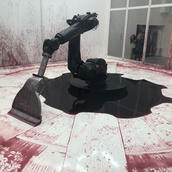
Sun Yuan and Peng Yu are regarded as two of China's most divisive artists. The artists' initial desire to test what could perhaps replace an artist's will in creating a work and how they could do so with a machine led to the decision to utilize a robot. They added a custom-designed shovel to the front of a robotic arm, which is commonly used on production lines such as those in car manufacture. Sun Yuan and Peng Yu are known for addressing controversial themes with dark humor. The robot’s repetitive movements are said to be a representation of the frustration around the never-ending issues on migration and sovereignty. Human-like actions can be observed from the machine who is trying its best to contain the red-spilled liquid from flowing further away. The red liquid that resembles bloodstains is a symbolism to those who suffer from the violence being evoked from the previously mentioned issues.
Helplessness is the very first thing that comes to mind as soon as an individual lays their eyes on this certain art piece. The constant and repetitive movements of the robots evoke frustration and pity from its audience as they can do nothing to help the robot but to observe it try its best to keep itself together, even when it’s obviously impossible to do so.
dreams, books, power and walls
꿈과 책과 힘과 벽
by JANNABI 잔나비, 2019
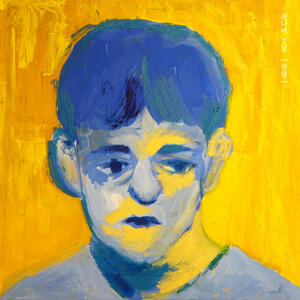
auditory art
click on the artwork to listen to the song.
# 2
dreams, books, power and walls is the 12th track in the album LEGEND from the korean band artist called JANNABI which was released in 2019. The band's vocalist, Choi Junghoon, wrote this song and he has always been vocal about how this is the song that feels very personal and special to him. He has also mentioned on several shows that this is his favourite song in their whole discography. This song was written based on Junghoon's own experience and how fast he felt he grew up, along with how hard it is to be an adult and the responsibilities that come along with it.
I have added this art in this exhibition as I felt helpless with how inevitable growing up is. No one prepares us for what we can experience once we go out in the real world, the adult world, and how terrifying it actually is. Mentioned in the song is how the person singing realized that their dream was too big and grand and that in real life, it's something he can't achieve and it will forever stay as a dream. As a kid, we say things like "I'm not going to be like my dad", or generally the stuff adults do that we are not very fond of. This song perfectly depicts how the adults we didn't want to become were probably just like us, and yet, as they get hit with the reality of the world, they slowly become the person they never wanted to be. And maybe somehow, someday, we will just be like them.
lyrics
해가 뜨고 다시 지는 것에
연연하였던 나의 작은방
텅 빈 마음 노랠 불러봤자
누군가에겐 소음일 테니
꼭 다문 입 그 새로 삐져나온
보잘것없는 나의 한숨에
나 들으라고 내쉰 숨이 더냐
아버지 내게 물으시고
제 발 저려 난 답할 수 없었네
우리는 우리는
어째서
어른이 된 걸까
하루하루가
참 무거운 짐이야
더는 못 갈 거야
꿈과 책과 힘과 벽 사이를
눈치 보기에 바쁜 나날들
소년이여 야망을 가져라
무책임한 격언 따위에
저 바다를 호령하는 거야
어처구니없던 나의 어린 꿈
가질 수 없음을 알게 되던 날
두드러기처럼 돋은 심술이
끝내 그 이름 더럽히고 말았네
우리는 우리는
어째서
어른이 된 걸까
하루하루가
참 무거운 짐이야
더는 못 간대두
멈춰 선 남겨진
날 보면
어떤 맘이 들까
하루하루가
참 무서운 밤인 걸
잘도 버티는 넌
하루하루가
참 무서운 밤인 걸
자고 나면 괜찮아질 거야
하루는 더 어른이 될 테니
무덤덤한 그 눈빛을 기억해
어릴 적 본 그들의 눈을
우린 조금씩 닮아야 할 거야
translation
The place where the sun rises and sets again
Hanging onto my small room
Even if I try to sing with an empty heart
It’s just noise to someone
The insignificant sigh that comes out of my lips which are tightly shut
My dad asks if I sighed for him to hear
Feeling guilty, I couldn’t dare answer
How did we
How did we become adults?
Each day is a heavy burden
I can’t go any further
Between dreams, books, power and walls
Days that are too busy to be wary of others
Boy, be ambitious
Such an irresponsible saying
Yelling out to the sea
My absurd little dream
The day I realized I couldn’t achieve it
My temper that broke out like hives
Eventually that name got tarnished
How did we
How did we become adults?
Each day is a heavy burden
I can’t go any further
When you stop and look at me who is left behind
I wonder what thought crosses your mind
Each day is a terrifying night
You’re enduring it well
Each day is a terrifying night
After you wake up from sleep it will be alright
Because you’ll be a day older
Remember those indifferent eyes
Those people’s eyes that we’ve seen when we were young
We’ll have to become a little more like them.
this is what self-destruction feels like
by Marina Lin, 2020
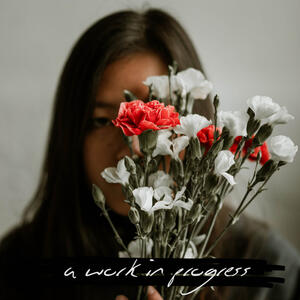
auditory art
click on the artwork to listen to the song.
# 3
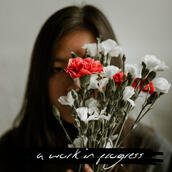
Marina Lin is a singer-songwriter from Toronto and she writes songs about various things: heartbreak, mental health, and everything in between. this is what self-destruction feels like is the 9th track from her album 'a work in progress' which was released in early 2020. Marina Lin has always been vocal about her mental health on her youtube channel 'Marina Lin' and she helps in breaking the stigma around it. This particular song is about the destructive behavior a person does to themselves, as a way to cope. These are unhealthy coping mechanisms that people use to combat anxiety, self-doubt, and shame.
This song portrays helplessness in a way because self-destruction is extremely hard to stop. Since it's considered a quick fix to our problems, it has an addictive nature to it. It is also interchangeable with self-sabotage; how we consciously or unconsciously block good things from happening to us and not allowing ourselves to nurture because we feel like we don't deserve it. This song shows the helpless cycle there is between a person and their self-destructive behavior.
lyrics
This isn't easy
I don't know how and what to feel
Keeping busy
It does the job but it doesn't heal
My mind is a fire
And I'm burning love away
It's getting harder to feel and they all say
You need to take care of yourself my darling
But they don't know how it feels to be broken
I can't help it, I feel numb
I'll wait for the waves to leave and come
I think I'm breaking
I'm a mess in the making
(Mmm mmm)
A mess in the making
(Mmm mmm)
I'm getting tired
Of the same old feeling in my chest
I'm not a liar
But I've got secrets I can't confess
lyrics
Don't say you love me
Cause I don't understand those words
It's getting harder to feel and they all sayYou need to take care of your health my darling
But they don't know how it feels to be broken
I can't help it, I feel numb
I'll wait for the waves to leave and come
I think I'm breaking
I'm a mess in the making
(Mmm mmm)
A mess in the making
(Mmm mmm)
I'm holding on a tightrope
And know I'm not coming home
Hurting, searching
You know I'm not coming home
This isn't easy
I don't know how and what to feel
Keeping busy
It does the job but it doesn't heal
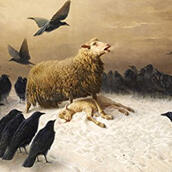
Anguish
by August Friedrich Schenck, 1878
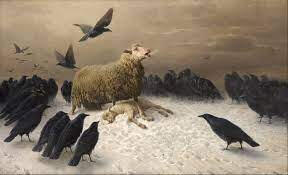
oil on canvas, 151.0 x 251.2 cm
# 4
August Friedrich Albrecht Schenck is a Danish artist who spent most of his career in France. He specialized in painting landscapes and animal subjects. August was a regular contributor to the Paris Salons for over 30 years, the place where 'Anguish' was first exhibited in 1878. Professionals have suggested that the art piece may have been inspired from Charles Darwin's 1872 book entitled 'The Expression of the Emotions in Man and Animals' where he argued that animals have similar emotions to that of humans. A bleating ewe is seen in the artwork, her breath freezing in the cold air. In a scenario reminiscent of a pietà, the mother sheep stands over the lifeless body of her lamb, a drip of blood running from its lips into the white snow. A swarm of black crows surrounding the two sheep, waiting for an opportunity to scavenge the corpse beneath a dreary grey gloomy winter sky. The dull hues of the artwork - almost monotone shades of white, grey, brown, and black – reflect the painting's depressing subject matter.
Helplessness and despair is visible in the ewe's face as she tries very hard to protect her dead lamb from the opportunistic crows that surround them despite knowing that it is impossible to do so because of the massive number of crows present in the scene.
The Unequal Marriage
by Vasilii Purkiev, 1862
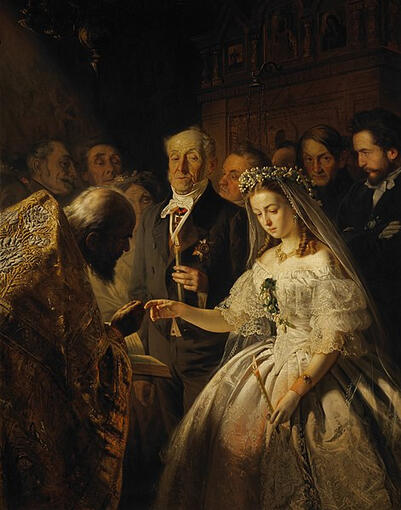
oil on canvas, 173 x 136,5 cm
# 5
Pukirev is a son of a peasant who was originally trained to become a painter. Pukirev had just graduated from School of Painting, Sculpture and Architecture in Moscow and this art piece was his successful attempt in painting something that is from a scene in a normal person’s life. The Unequal Marriage depicts a wedding ceremony scene of an old man and a young girl. The girl in the white wedding dress is highlighted compared to the rest of the dim part. She is quite young and pretty, but no happiness can be seen on her face. She bows her head, and her eyes look red as if she has been crying all night the day before as she is to marry someone who is probably the age of his grandfather. It is suggested that this work is based on a real life experience of Purkiev’s friend, Sergei Varentsov, as he fell in love with a girl who was to marry a rich merchant.
Being married to someone twice your age, and someone you don’t love is something very common during that time as people strive to marry their daughters’ off to rich old men in order to survive in the harsh world. The fact that the young girl couldn’t raise her head as she reaches out her lifeless hand for the ring perfectly depicts defeat and helplessness to the situation she is in. The way the old man, who is speculated to be the groom, and the bride hold their candles also symbolizes the differences of their outlook regarding the wedding. The two visibly young men at the right-most side of the painting are said to be Purkiev, the artist himself, and his friend, Sergei Varentsov. Their stares are significantly different than the rest of the people in the room. They are full of sadness, pity, and are helpless with the situation unfolding right in front of their eyes because they simply can’t do anything to stop it.
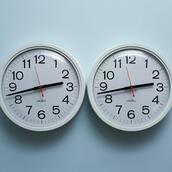
Untitled (Perfect Lovers)
by Felix Gonzales-Torres, 1991
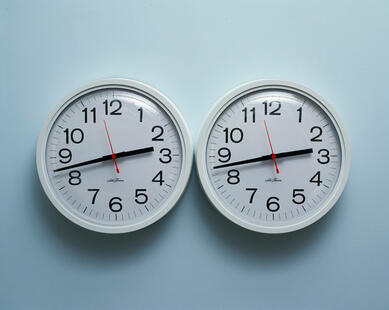
clocks, paint on wall, overall 35.6 x 71.2 x 7 cm
# 6
Felix Gonzales-Torres is a Cuban-born American artist that is famous for his minimal sculptures and installations that make use of everyday materials. He is an open gay artist and some of his works are speculated to be a reflection of his experience with AIDS. This certain artwork is for his partner, Ross Laycock, who is an HIV positive. Perfect Lovers consists of two clocks that start in synchronization. Slowly and expectedly, they fall out of time. This is caused by running out of batteries as well as the nature of the mechanism. It symbolizes the decline of his partner's health and how with every tick of the clock, he is slowly getting closer to his death due to his disease. The two clocks represent two mechanical heartbeats, which are illustrative of the two lives ordained to fall out of sync and carry moving poetry about personal loss and the temporal nature of life.
The artist has admitted that this certain piece was the scariest thing he has ever done. He is someone who is scared of time, as we all are. This piece is something the artist did because he wanted to face the inevitable death of his lover with every tick of the clock. Their situation is extremely beautiful, and yet, tragic; a bittersweet representation of the two lovers. Felix holds on with every memory he can make with Ross as his time slowly withers away, helplessly.
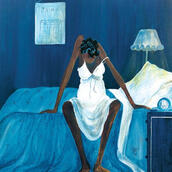
Blue Monday
by Annie Lee, year unknown
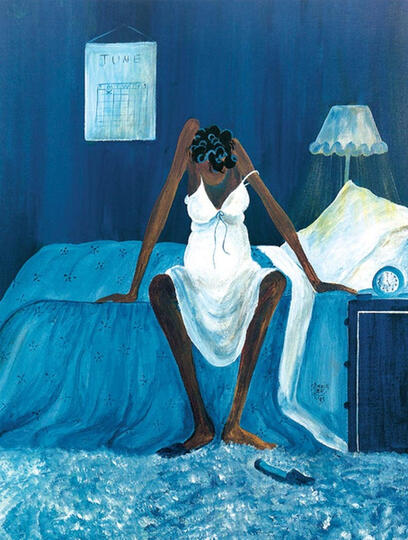
18 x 23 inches
# 7
Annie Lee has been a significant and recognized personality in the world of art since she stormed her first gallery show at the age of 50 in 1985, where her artwork got sold out in just four hours. Because of her utilization of images of common African-American life, the vivid feeling of the individuals, and two-dimensional forms, her technique was dubbed "Black Americana" by art critics. Another distinguishing feature of her work is that her subjects were frequently faceless. In her paintings, she employed body language to convey emotion and expression.
Seen in the painting is a figure of a woman getting up from her bed to start her day. This is a portrait of Annie on one Monday morning, at five o'clock, starting to get ready to go to work on a cold winter morning. The blue tint of the painting gives more emphasis on the coldness of the room she is in. This piece perfectly describes the feeling of not wanting to get up in the morning and yet, having the need to do so for your children. This is a continuous cycle that one experiences and it is no doubt that an individual may feel helpless if they are in the said repetitive situation.
you've reached the end of the exhibit. thank you!